
EVIDENCE: How Ghana’s Washington Embassy staff shared money extorted from visa and passport applicants
A forensic audit by the Auditor-General has revealed an elaborate scheme adopted by the Ghana Embassy staff in Washington, D.C., to share the money the embassy extorted from visa and passport applicants between 2019 and 2025.
The audit, which covers operations at the embassy from 2017 to 2025, revealed disturbing details of financial and other schemes that embassy officials designed and generated millions of dollars outside approved charges.
The audit report, which is available to Pledge Against Corruption, puts the total amount of illegal funds at $19.4 million, generated from 2019 to 2025, when the illicit transactions at the Embassy were uncovered and halted by the new administration.
Websites and firms linked to the embassy’s IT Officer, Fred Kwarteng, were used to charge applicants $29.75 for the return posting of their visa and passport applications, when the actual charge was around $10.1.
For instance, the report revealed the creation and use of the GhanaPV.Org website, which was used to mimic the Embassy’s official website and confuse unsuspecting applicants into believing they were dealing with official channels.
The Auditor-General's report said: “The audit proved that Ghanapv.org, created in September 2020, replicated official Embassy branding by using Ghana’s Coat of Arms, the name ‘Embassy of Ghana,’ and official contact details. The website redirected applicants from the Embassy’s website to pay fees for postage and application support services. Applicants were charged $29.75 for return postage and additional support service fees through the platform. The site operated under many entities related to Mr Fred Kwarteng.”
According to the audit, Ghanapv.org operated under various companies linked to Fred Kwarteng, including Ghana Travel Consultancy (GTC), Secure Data Center LLC, Travel Ghana, Travel Global, Secure Document Management Center (SDMC) and MFG Technology.
The audit report continued: “The domain TravelGhana.net, originally developed between 2013 and 2014 and relaunched in January 2021, offered mailing and application support services for visa and passport applicants. The platform charged $29.75 for mailing services, $67 for passport support, and $76.78 for visa support services. The website used Ghana’s Coat of Arms and Embassy-like branding between 2021 and 2024, creating the appearance of official affiliation with the Embassy."

The audit report, which cites Fred Kwarteng in other infractions, accuses senior embassy officials of complicity in his activities.
It said: “Email correspondence and internal records show that the activities of Mr Fred Kwarteng were enabled through financial and consular channels involving senior Mission officers. Evidence indicates that the Chief Treasury Officer engaged in actions involving welfare account transactions, payment arrangements, and operational coordination with Mr Kwarteng’s associated entities.
"Correspondence also shows that the Minister (Consular) participated in and was copied on communications where private entities linked to Mr Kwarteng handled dispatch services and courier arrangements. These interactions occurred between 2020 and 2024 and involved redirecting applicants to Fred Kwarteng’s private platforms. The communications demonstrate sustained engagement between the officers and Mr Kwarteng’s activities within Mission operations,” The report said.
Citibank staff queries Embassy officials over suspicious account
Details of the operations contained in the appendix of the Auditor-General’s report show what appeared to have been a grand scheme to “create, loot and share,” with the active participation of senior embassy officials.
The audit report reveals that the Ghana Embassy in Washington, D.C., created a bank account through which funds from Fred Kwarteng’s activities were channelled and paid to embassy officials under the guise of “welfare benefits.”
Even before the then Foreign Affairs Minister, Shirley Ayorkor Botchwey, ordered the closure of the account, Citibank, where the Welfare account was opened, had raised queries about the account.
On March 16, 2020, Janet Maku Koranteng, the Treasury Officer of Ghana’s Embassy in Washington, D.C, wrote to Citibank about the opening of an account. In that letter, she said:
“On behalf of the Ghana Embassy/Mission in Washington DC, this letter is to advise that effective date April 1, 2020, you are requested to open a new account titled Embassy of Ghana Welfare Account.”
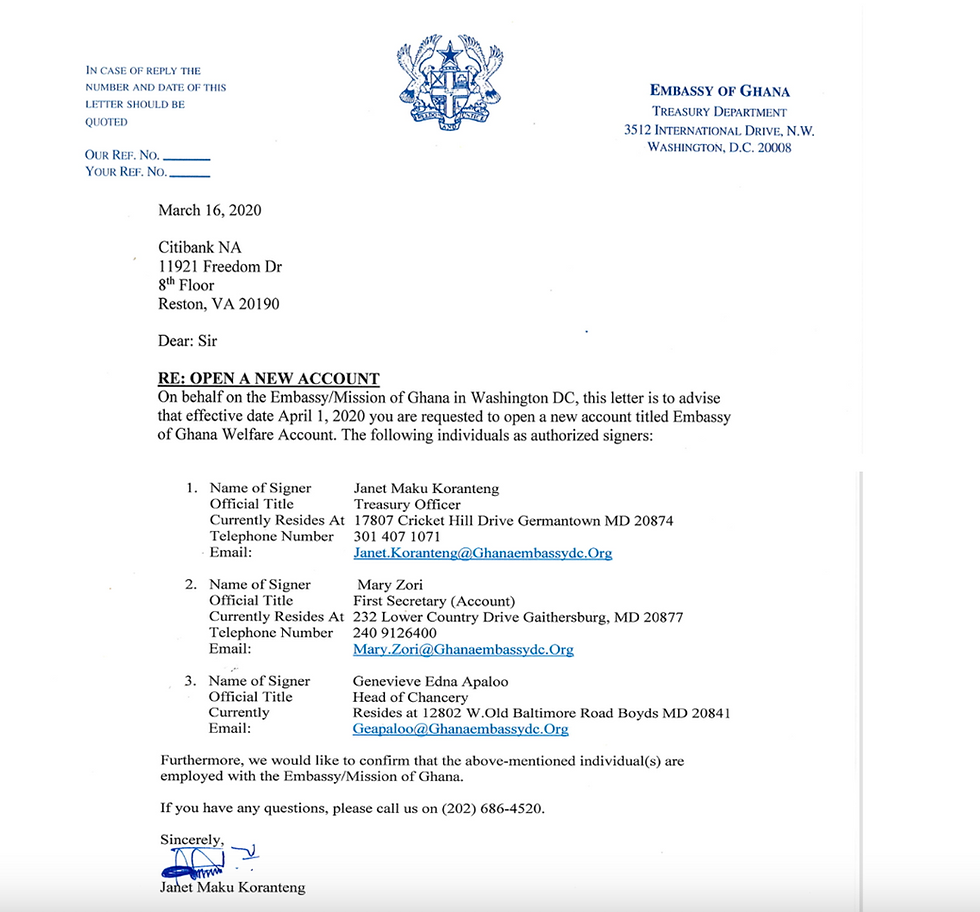
She listed the account signers as Mary Zori, First Secretary; Genevieve Edna Apaloo, Head of Chancery; and herself, Janet Maku Koranteng.
The first query from Citibank was an email from a Citibank staff member, Melissa Peredo, seeking clarification on whether the $80,000 intended to be withdrawn every quarter from the Welfare account as payment for staff welfare would be made in cash or by cheque.
On September 4, 2020, another Citibank staff member, Jay Varkey, sent an email to Janet Maku Koranteng, querying her about payments into the Ghana Embassy Welfare Account.
“A/c ending 9029, which was recently opened, is intended to make welfare benefit payments to Embassy staff. At the time of the account opening, you indicated that this account will [sic] be funded by contributions from the Embassy staff and also from contributions from the Embassy’s couriers.
“The only funding to this account so far were from Ghana Travel Consultancy LLC by way of three checks indicated below. Is this the Embassy Courier that you indicated?
“Maybe I misunderstood this part, but could you please explain what Gana Travel Consultancy does for you? Are they just a courier service or are they actually processing the consular service applications on your behalf? Also, why are they making these payments to the Embassy?”

Ghana Travel Consultancy is one of the entities linked to Ghana Embassy’s IT Officer, Fred Kwarteng.
Following this email, Citibank’s Jay Varkey and the Ghana Embassy’s Janet Koranteng discussed the query on the phone. After the call, Jay Varkey sent the following email to Janet Koranteng to confirm the explanation Janet had given for the payments from Fred Kwarteng’s entity:
“Please confirm if this accurately summarises our conversation. The consular service applicants can choose a courier/ mailing service of their choice when they apply for passport/visa etc. They make separate payments to such courier/mailing service. These payments are not collected by the Embassy and they do not pass through the Embassy accounts. Once the consular service process is completed, the Embassy will use the selected courier/mailing service to send back the documents to the applicants.
However, since Embassy staff is doing some of the administration work that the courier/mailing service should be doing (e.g. packaging, etc.), the courier/mailing service has agreements to reimburse the Embassy a portion of the charge that they have collected towards mailing. This will vary for different kinds of applications, but it’s generally in the range of $3 to $5 per application processed. The reimbursed money is credited to the Welfare account and is used for Welfare payments to the Embassy staff.
“Gana Travel Consultancy LLC is one of the courier/mailing service providers that is used. They will send reimbursements as described above to the Embassy on a monthly basis. Check 1010 is towards the reimbursements for the month of December 2019, check 1007 is towards the month of January 2020, and check 1008 is towards reimbursement for the month of February 2020.”

An appendix of the Auditor General’s report shows disbursements to staff made from the so-called welfare account.
In June 2021, the Minister for Foreign Affairs, Shirley Ayorkor Botchwey, visited the Ghana Embassy in Washington, DC, and ordered the closure of the welfare account used to distribute proceeds from illicit funds.
The account was closed as ordered by the Foreign Affairs Minister, but officials of the Ghana Embassy did not abandon their desire to continue with the scheme.

While communicating the closure of the account to Citibank in an email on August 31, 2021, Janet Koranteng asked if another account could be opened without officially involving the Embassy.
“Can the Welfare Committee open an account without the involvement of the management of the Embassy?” she asked.
In a response, Citibank's Jay Varkey said, “Citi will not be able to open/maintain the welfare account separately (under non-embassy management) as long as the purpose of the account remains the same (for making welfare payments to embassy employees).”
The account was officially closed on October 10, 2021.
However, the illicit transactions that caused visa and passport applicants to pay far more than they were supposed to pay continued until 2025, when the cover on the Embassy's underhand dealings was blown, necessitating the subsequent forensic audit.


Comments